
For my student teaching I was in a 7th grade inner-city geography class. I taught 3 sections of Introduction to physical geography in which each student was required to understand the physical world around them and how we as people fit into it.
Most of the students were burnt our by the time they got to me, so looking to find creative ways to teach landforms and bodies of water was essential. Because if they didn’t learn that, then the rest of our semester was a moot point.
Therefore, we built maps, recreated bodies of water, and used a hands-on approach to make sure every child was well-familiarized with each land and water form. But the absolute easiest way to start learning basic geographic terms is through 3-part puzzles, our favorite being Landform Match-ups!

Using Landforms Match-ups to meet Elementary and Middle school Learning objectives
Identify and describe several common landforms
This can be those indicated within the game or other. Have students go through all landforms and even have the work on classifying them [let students choose their own ways to classify to see what they come up with]. This could include how big they are or ordering them from largest to smallest. Maybe grouping them based on land vs. water or other.
Locate landforms learned on a map
By pulling out a local, state, country, or even world map, kids can immediately start identifying the landforms they’re learning. For instance, Florida is the most obvious and easiest peninsula to teach!
Compare and contrast similar landforms or bodies of water
Whether written or verbally, kids should be able to differentiate between two like landforms without directly reading definitions. For instance have them compare and contrast peninsula vs. isthmus or even less obvious comparisons like strait vs. isthmus.
Landforms Match-Ups quick facts
- Game Title & Company 🎲 Landforms Match-Ups by Lakeshore Learning
- Average Time to Play ⏳15-25 minutes or up to 45 minutes with an analysis and application activity
- Subjects or Learning Objectives 📚Identify and define Geographic landforms
Lesson Plans: Coming Soon
Supplemental Resources: 4 printable games to learn basic geography
How we rate the game:
⭐️⭐️⭐️⭐️✩
This is a really great way to teach children of multiple ages their landforms. We have used it in conjunction with the computer game Civilizations to help our kids understand the terms we’re using. The nicest part is that it’s 100% self-correcting which means that a student can sit down with it and play it completely alone and know if they’ve successfully matched each piece or not. The one and only reason we do not give it 5 stars is because the pieces are a loose fit, meaning that the cleanup and storage [aka, trying to get the box closed] is a complete nightmare.
Our website participates in affiliate marketing; we earn from qualifying purchases.*
Where to buy:
♦️Lakeshore Learning
♦️You can sometimes find them on *eBay!
♦️We also highly recommend *Montessori Land and Water Form Cards
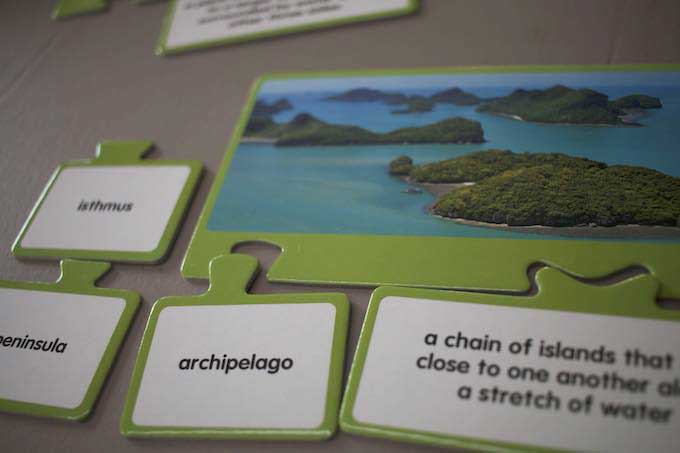
Geography Landform Puzzle Game
In the box are 15 different landforms and bodies of water, so it’s not exhaustive in terms of what students can learn. However, the nice aspect is that kids can actually think to identify other landforms not covered and define them both on their own and by doing research [this allows for some critical thinking and teaches them to use educational reference materials, therefore covering a few more learning objectives.
Each puzzle is three pieces and has a picture, name of geographic topic, and definition.
It is self correcting in that each hole and and puzzle knob is a different size, shape, and orientation so that only the right term and definition fit with its picture.
Supplemental resources to help kids understand geography
- Make 3-D Salt Dough maps
- Go more in depth learning about landform with this educational video.
- National geographic has great images of real-life landform examples.
Even more resources you’ll enjoy

Join other tabletop teachers & parents!
Join our community and newsletter for updates, offers, and more!
 How to create board game traditions to enjoy the entire year