
Every child comes in contact with puzzles in the first few years of life, but often they are overlooked and undervalued. However, did you know there is scientific research actually proving that puzzles boost kids’ brain development?
From simple block puzzles to complex and giant 3-foot floor creations, puzzles of all varieties help kids understand their world better how how things fit together — both figuratively and literally.
Related: 5 research-backed ways board games influence reading success
What kids of all ages can learn from puzzles
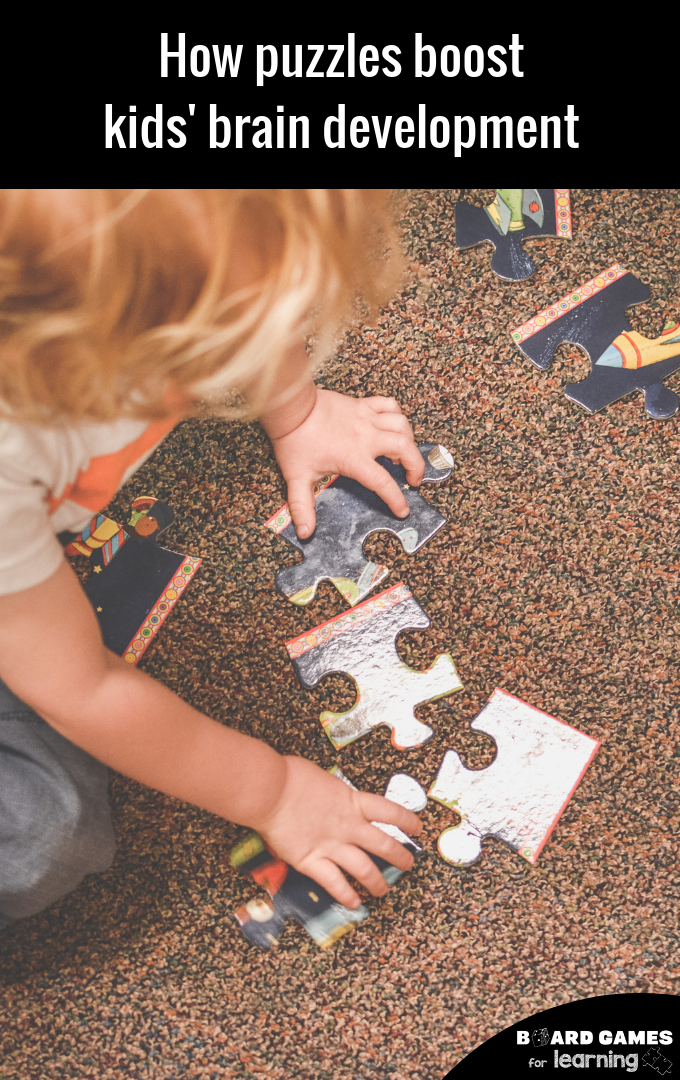
Spatial Awareness & Perceptual Context
Spatial awareness is probably the most obvious benefits of puzzles…
How big is the piece or space?
What shape does it make?
What’s the picture trying to show?
What colors match?
According to research published in Developmental Psychology in 2012, children who were observed playing with puzzles performed better at tasks involving mental transformation of 2-dimension shapes than of those who did not participate in puzzle play.
In fact, kids of all ages form some sort of internal idea of what should go where and how. So as we introduce very young kids to puzzles, they are learning how pieces fit into a bigger pictures just as they’re learning about how lids go on containers or clothes go into drawers; it gives them perceptual context for their brains (Bretherton, 2014).
One of our favorite toddler puzzles doesn’t have the knob-like shapes for fitting together, rather it’s a bunch of squares and rectangles. It’s a cityscape, but the underlying image is what would be under the buildings. So maybe a home has a family inside the house or behind the car is the street.
There are puzzles of all types and even for different purposes, but all help with spatial and perceptual thinking.
Puzzles require divergent thinking
Divergent thinking is a thought process of exploring many possible solutions and it’s typically non-linear. Therefore, picking up a puzzle piece one by one in no specific order, trying to find its places, helps kids to use divergent thinking. In the future this can help in problem solving and analyzing situations in the workplace.
Puzzles Develop mathematical thinking and understanding
At the most very basic level, shapes are geometry. But think about puzzle pieces. Think about how with a jigsaw puzzle, each pieces has knobs and notches. Some of them are much larger than other while some might even more shaped a bit differently. Kids can starting thinking in terms of size and ratio without even realizing it just by fitting puzzles together.
Even “preschoolers explore patterns and shapes, compare sizes, and count things” and this is all readily available in puzzle play allowing them to “engage in informal mathematical activity” (Sarma, 2009).
In fact, there are six basic mathematical learning associated with puzzle play according to the American Journal of Play:
- Classification – sorting by size, shape, color.
- Magnitude – how big or small a piece or part is.
- Enumeration – how many are left or missing.
- Dynamics – related to putting things together/taking them apart or even the need for flipping pieces.
- Pattern & Shape – identifying a visual pattern or attribute to know what comes next.
- Spatial Relations – knowing where something goes or how it fits into the larger context.
The great thing about puzzles is that there are even challenging tile sets for adults. So as kids and teens grow, they can continue to challenge and grow their minds in these six ways.

Solitary Play
Yes, socialization is key for kids at all ages, but so is the ability to think for oneself and master something individually.
In terms of brain development, solitary play improves executive functioning. That is, it encourages children to manage themselves, their resources, their time, etc. in order to achieve a goal. Executive functioning relies on working memory, planning, and flexibility… all things necessary to complete a puzzle alone. Furthermore, as executive functioning develops, so does the prefrontal cortex. So completing puzzles individually can literally help grow the brain. (The Power of Play, n.d.)
Favorite Puzzles & Puzzle Brands
As an Amazon Affiliate, we earn from qualifying purchases.
- Frank Schaffer Publications: We have two 2-sided floor puzzles form this company that are fantastic. One is a castle, the other a mummy sarcophagus. They’re our favorites by far because of the quality but also because they bridge multiple age ranges. They also come with little figures to continue to play with the puzzle as a scene, so kids aren’t so quickly over it once it’s put together.
- Sticker Puzzles:Whether it’s a “paint” by sticker or sticker number puzzles, we enjoy these quite a lot. They help both with the puzzle as a picture, but also number identification. Plus they’re easy to take on the go whether across town to an appointment or across the globe on a plane.
- Ravensburger: We love these because they can grow with kids. They make pieces in a certain size based on age and usually even show a scale of it on the back of the box. So whether your kids need just a sixty piece puzzle or one thousand, they have the options!
- Smart Games: They make a variety of more game-like puzzles. We have several such as a Squirrels Go Nuts or IQ XOXO. What we love about this type of puzzle is that they’re typically easy enough to start with very young children, but get exponentially more challenging so even adults can feel stumped at times. To us, that’s the sign of a really great puzzle.
Connect with us & get news
Join our community of educators, parents, and homeschoolers that love games and especially enjoy using them to teach! You’ll get a newsletter for updates, offers, free printables, and more!
Resources
- Bretherton, Inge. Symbolic Play: the Development of Social Understanding. Elsevier Science, 2014.
- “Developing Young Children’s Mathematical Thinking and Understanding.” The Routledge International Handbook of Young Children’s Thinking and Understanding, by Sue Robson, Routledge, 2015, pp. 331–344.
- Levine, Susan C., et al. “Early Puzzle Play: A Predictor of Preschoolers’ Spatial Transformation Skill.” Developmental Psychology, vol. 48, no. 2, 2012, pp. 530–542., doi:10.1037/a0025913.
- Lloyd, Bronwen, and Nina Howe. “Solitary Play and Convergent and Divergent Thinking Skills in Preschool Children.” Early Childhood Research Quarterly, vol. 18, no. 1, 2003, pp. 22–41., doi:10.1016/s0885-2006(03)00004-8.
- Sarama, Julie, and Douglas H Clements. “Building Blocks and Cognitive Building Blocks Playing to Know the World Mathematically.” American Journal of Play, 2009, pp. 313–337., doi:https://files.eric.ed.gov/fulltext/EJ1069014.pdf.
- The Power of Play. (n.d.). [ebook] Minnesota Children’s Museum. Available at: https://www.childrensmuseums.org/images/MCMResearchSummary.pdf [Accessed 10 Nov. 2018].
- Verdine, Brian N., et al. “Deconstructing Building Blocks: Preschoolers’ Spatial Assembly Performance Relates to Early Mathematical Skills.” Child Development, vol. 85, no. 3, 2013, pp. 1062–1076., doi:10.1111/cdev.12165.
- Verdine, Brian N., et al. “Finding the Missing Piece: Blocks, Puzzles, and Shapes Fuel School Readiness.” Trends in Neuroscience and Education, vol. 3, no. 1, 2014, pp. 7–13., doi:10.1016/j.tine.2014.02.005.
 Had enough paying full price for board games? How to pay less but buy more
[…] Related: How puzzles boost kids’ brain development […]