
As a really little kid, I vividly remember going out to my grandparents’ house whether on a weekend or for a holiday and there would always be a game of Canasta playing under the kitchen fan. I had my own special chair and my own pad of drawing paper and I would color and sketch as the adults played a game. And that was part of the culture our family created.
Now, I have young kids. This means not only do my husband and I desire time to play games and card with our adult company, but it also means that even trying to enjoy a board game with our oldest means trying to keep the baby and toddler from ruining it all.
But we still bring them to the table. And they’re still a part of the family game culture we’re trying to create.
Why?
Because we don’t want to push them away from games, we want them to know they too will be a part of it one day.
How to play board games with a toddler or baby around
Choose the right game
This doesn’t mean choosing a kid game necessarily, but it means being mindful of the distractions you might have as a supervising adult.
We once played Dixit with 4 kids under the age of 5 in our home. It was do-able. And that’s because it didn’t demand our undivided attention, it allowed some wiggle room to come and go as needed and it wasn’t so long that having disruptions was an issue.
Use a high chair or set up a play area
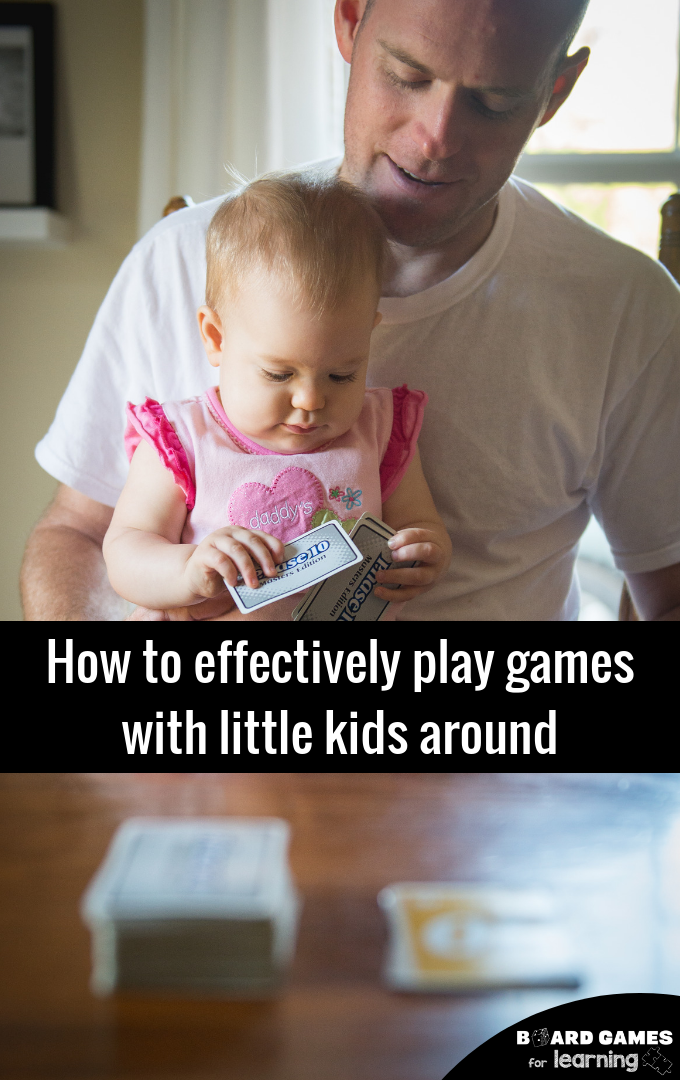
Obviously finding a way to contain the kids is helpful. We like to bring them to the table when possible, just like I was invited to sit with family as they played a card game way over my understanding level [but you better believe I learned it. I learned it by watching and when I was only about 8 or 9, I was playing too].
Even if you can have a play area near the table, it helps kids to feel close and helps parents to keep a close eye.
Give them a similar activity with spare parts, pieces, and cards for just them
Playing with dice? Have some jumbo dice just for them.
Card game? Surely you have some old ripped or worn cards they can use.
Board games? Buy up the games without all the pieces at the thrift stores to have some extras.
In fact, even kids that are about 3 and older can start to try to come up with ideas and games of their own. So inspire and allow that creativity.
We once played Banagrams at a friend’s house and our 5 year old daughters t the time both made their own version of the game from paper!
Allow extra time for interruptions
Don’t play Risk. Or Monopoly.
Choose something that everyone, even non-players can have an attention span for. This means choosing something that is between 15-45 minutes regularly might now be 25-71 minutes. And that’s feasible on some scale.
Let the kids help
Let the kids help hold the cards, place the tile, or otherwise be involved. It really is ok to bring them to the table.
And consider getting an anti-slip mat. There are less likely to be big catastrophes!
Be Flexible
Just like allowing for extra time, it’s also important to just overall allow for the unexpected. Bumped tables [like mentioned above] or even mistakes in playing a game are common with kids running around. But having a flexible attitude makes all the difference.
Join other parents and teachers who love tabletop games!
Get news and resources by subscribing to our mailing list. It’s a great way to join the community and get updates, offers, and more!
 How to get started teaching children sudoku